Circuit Diagrams
Historical reference
This page is retained from the previous design documentation. Parts, geometry, status and numerical claims may be superseded. Start with thecurrent architecture and verify exact components in thecatalog. See the archive guide for context.
Complete circuit configuration shown in stages.
These diagrams cover the Board B conversion chain (DC-DC → LDO → protection). The USB-PD front end that feeds it now lives on Board A and is documented in Board A: USB-PD Core — see USB-PD Input Stage (Board A) below.
Power Flow Overview
This diagram shows the complete power conversion chain from USB-C input to all output rails, including the relationship between all circuit diagrams.
Power Conversion Strategy:
Two-stage design: DC-DC converters provide efficient voltage reduction, linear regulators provide low-noise final outputs
+12V rail: USB-C 15V → Buck (U2) → LDO (U6) → +12V OUT
+5V rail: USB-C 15V → Buck (U3) → LDO (U7) → +5V OUT
-12V rail: USB-C 15V → Inverting Buck-Boost (U4) → LDO (U8) → -12V OUT
USB-PD Input Stage (Board A)
The USB-PD front end is no longer documented here. It moved to its own board and its own page when the project split in two: Board A: USB-PD Core carries the STUSB4500 (U1), the USB-C receptacle (J1), the Q1 load switch and its gate network, the D5 VBUS clamp, the D8 gate-source zener, and the J4 interface connector that feeds Board B's +15V rail.
That page is generated against scripts/, the spec module that boards/ is built from, so it stays in step with the schematic. The ASCII drawing that used to sit here did not: it still showed D4 (USBLC6-2SC6), a part removed entirely from the design, and R17/R18 as fitted when both are now DNP.
Start with these sections of the Board A page:
Net-connectivity table — the authoritative pin-to-net record, replacing the old ASCII schematic
Deltas vs the current single-board circuit — what was removed, set DNP, rewired, and added
Load switch: Q1 gate network and soft-start — the R11/R12/C35 network and the 5.6 ms time constant
Power sequencing (VBUS_EN_SNK) — the negotiation-to-power-on sequence
A↔B interface contract — the J4/J5 pinout this page's
+15Vinput arrives on
Diagram numbering is unchanged
The remaining diagrams keep their original D2–D7 numbers and anchors, so existing links into them still resolve. There is no Diagram1 any more.
Diagram2: USB-PD +15V → +13.5V Buck Converter (LM2596S-ADJ #1)
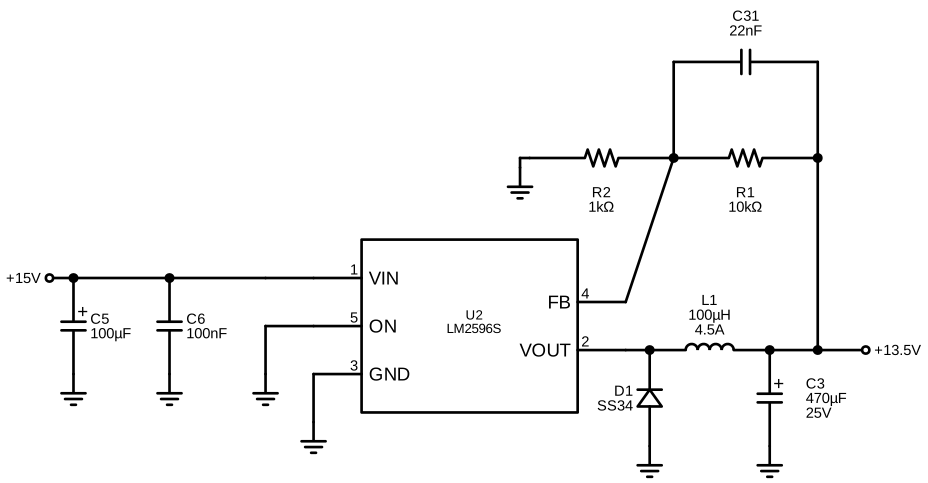
Key Points:
Two-stage design: Buck converter (U2) reduces voltage with high efficiency, then linear regulator (LM7812) provides low-noise final output
Capacitor order: C5/C6 (input filter) → [U2 + L1] → C3 (buck output filter) → [LM7812] → output capacitors
C3 role: Filters switching ripple from buck converter before feeding the linear regulator
Switching node: Junction at OUTPUT pin 2, where L1 and D1 cathode connect
D1 flyback path: Provides current path when U2's internal switch is OFF (D1 cathode → switching node; D1 anode → GND)
L1 output and D1 anode are completely separate paths - they do NOT connect to each other
View ASCII art circuit
Buck Converter IC:
Connection List
Input Power: - +15V input → U2 (LM2596S-ADJ) pin 1 (VIN) - GND → U2 pin 5 (ON/OFF) (always-on: tie to GND or leave floating) Output Path (Buck Converter Topology): 1. U2 pin 2 (OUTPUT) → L1 (100µH, 4.5A) → Junction point 2. Junction point → C3 (470µF/25V) → GND (output filter capacitor) 3. Junction point → +13.5V output (to next stage) Flyback Diode (Freewheeling Diode): - D1 (SS34 Schottky): - Cathode → Junction between OUTPUT (pin 2) and L1 - Anode → GND - Purpose: Provides path for inductor current when switch turns off Input Capacitors: - C5 (470µF/35V electrolytic): +15V input ⟷ GND (bulk input filter; raised from 100µF/25V by wave-6 decision (d)) - C6 (100nF ceramic): +15V input ⟷ GND (high-frequency decoupling) Output Capacitor: - C3 (470µF/25V electrolytic): Connected in parallel between +13.5V output ⟷ GND - Purpose: Output filtering, ripple reduction, and energy storage for transient response - Important: C3 is NOT in series with the output - it's a shunt element that allows AC ripple current to flow to GND Feedback Network (Voltage Setting): - Voltage divider: +13.5V output → R1 (10kΩ) → Tap point → R2 (1kΩ) → GND - U2 pin 4 (FB) → Connected to tap point (junction between R1 and R2) - The tap point voltage = 13. - Chip maintains FB pin at 1.23V by adjusting duty cycle - Output voltage formula: VOUT = Ground: - U2 pin 3 (GND) → System GND - All capacitor negative terminals → System GND - D1 anode → System GND Key Points: - The inductor L1 is on the OUTPUT side of pin 2 (OUTPUT), not the input side - D1 cathode connects to the junction between OUTPUT (pin 2) and L1 (the "switching node") - When U2's internal switch is ON: Current flows VIN → Switch → OUTPUT → L1 → C3 → Load - When U2's internal switch is OFF: Inductor current flows through D1 (L1 → D1 → GND → L1)
Diagram3: +15V → +7.5V Buck Converter (LM2596S-ADJ #2, U3)
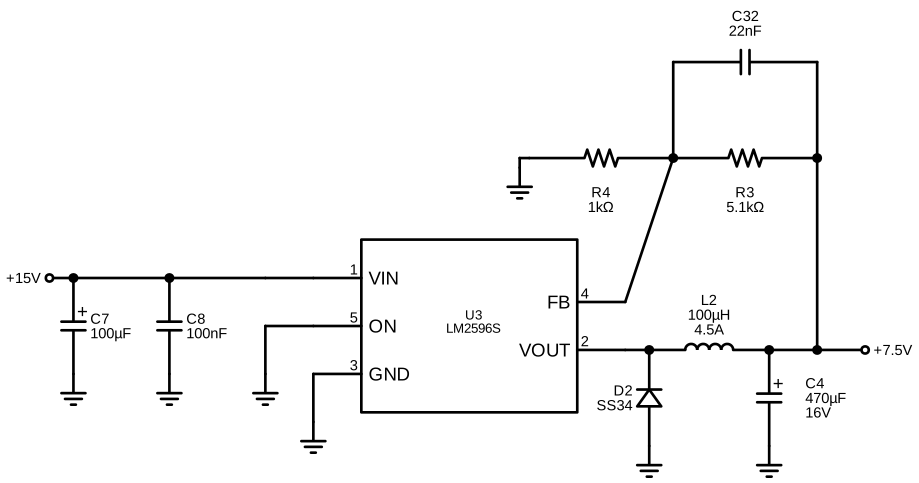
Key Points:
Switching node is the junction at OUTPUT pin 2
Path 1: Switching node → L2 → +7.5V output (main current path)
Path 2: Switching node → D2 cathode; D2 anode → GND (flyback/freewheeling path)
D2 has exactly 2 connections: cathode to switching node, anode to GND
L2 output and D2 anode are completely separate paths - they do NOT connect to each other
View ASCII art circuit
Input: ### Feedback Network (Voltage Divider with Compensation) Feedback Network (Voltage Divider with Compensation):
Connection List
Input Power: - +15V input → U3 (LM2596S-ADJ) pin 1 (VIN) - GND → U3 pin 5 (ON/OFF) (always-on: tie to GND or leave floating) Output Path (Buck Converter Topology): 1. U3 pin 2 (OUTPUT) → L2 (100µH, 4.5A) → Junction point 2. Junction point → C4 (470µF/10V) → GND (output filter capacitor) 3. Junction point → +7.5V output (to L7805 linear regulator) Flyback Diode (Freewheeling Diode): - D2 (SS34 Schottky): - Cathode → Junction between OUTPUT (pin 2) and L2 - Anode → GND - Purpose: Provides path for inductor current when switch turns off Input Capacitors: - C7 (470µF/35V electrolytic): +15V input ⟷ GND (U3's own bulk input filter — U2 has its own pair, C5/C6) - C8 (100nF ceramic): +15V input ⟷ GND (high-frequency decoupling) Output Capacitor: - C4 (470µF/10V electrolytic): Connected in parallel between +7.5V output ⟷ GND - Purpose: Output filtering, ripple reduction, and energy storage for transient response - Important: C4 is NOT in series with the output - it's a shunt element that allows AC ripple current to flow to GND Feedback Network (Voltage Setting): - Voltage divider: +7.5V output → R3 (5.1kΩ) → Tap point → R4 (1kΩ) → GND - U3 pin 4 (FB) → Connected to tap point (junction between R3 and R4) - The tap point voltage = 7. - Chip maintains FB pin at 1.23V by adjusting duty cycle - Output voltage formula: VOUT = Ground: - U3 pin 3 (GND) → System GND - All capacitor negative terminals → System GND - D2 anode → System GND Key Points: - The inductor L2 is on the OUTPUT side of pin 2 (OUTPUT), not the input side - D2 cathode connects to the junction between OUTPUT (pin 2) and L2 (the "switching node") - When U3's internal switch is ON: Current flows VIN → Switch → OUTPUT → L2 → C4 → Load - When U3's internal switch is OFF: Inductor current flows through D2 (L2 → D2 → GND → L2) - This stage provides +7.5V to the L7805 linear regulator for final +5V output
Diagram4: +15V → -13.5V Inverting Buck-Boost (LM2596S-ADJ, U4)
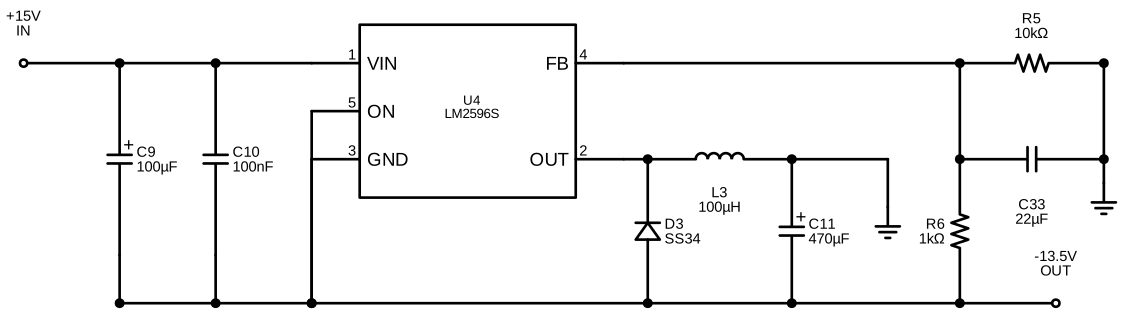
Key Points:
Inverting buck-boost topology: LM2596S-ADJ configured to convert positive input to negative output in a single stage
Bootstrapped ground: IC GND pin connected to negative output (-13.5V), allowing FB pin to regulate correctly
High efficiency: Single-stage conversion eliminates intermediate -15V stage
Same IC family: Uses LM2596S-ADJ (same as Diagram2/3 buck converters)
Input voltage: +15V from USB-PD
Output voltage: -13.5V (feeds LM7912 linear regulator for final -12V output)
Current capability: 800mA+ (sufficient for -12V rail)
Switching frequency: 150kHz (LM2596 default)
View ASCII art circuit
Inverting Buck- Component Selection: - U4: LM2596S-ADJ (same IC as Diagram2/3) - L3: 100µH inductor, 4.5A saturation current rating (same as Diagram2/3) - D3: SS34 Schottky diode, 3A, 40V (LCSC C8678 — the same part as D1/D2; catch diode from SW to -13.5V, 40V reverse rating against the 28.5V nominal VIN+|VOUT| stress = 1.4× margin) - C9: 100µF electrolytic, 50V rating (input bulk, sees VIN+|VOUT| = 28.5V) - C10: 100nF ceramic, 50V X7R (input decoupling) - C11: 470µF electrolytic, 25V rating (output filter - single cap, LM7912 filters downstream) - R5: 10kΩ ±1% (feedback upper resistor) - R6: 1kΩ ±1% (feedback lower resistor) - C33: 22nF ceramic, 25V X7R (feedback compensation, parallel with R5) Key Design Notes: 1. Bootstrapped Ground: IC GND pin connects to negative output, not system ground 2. Input Voltage Stress: Input caps see VIN + |VOUT| = 28.5V (use 50V rating) 3. Diode Selection: D3 must handle VIN + |VOUT| reverse voltage (SS34's 40V gives 1.4× margin at the 28.5V nominal stress) 4. FB Pin Safety: FB is always +1.23V above IC GND (safe, within spec) 5. Single Stage: Eliminates intermediate -15V conversion, improves efficiency 6. Output Polarity: Output capacitor C11 has + terminal to System GND (0V), - terminal to -13.5V
Connection List
Input Power: - +15V input → U4 (LM2596S-ADJ) pin 1 (VIN) - U4 pin 3 (IC GND) → -13.5V output (bootstrapped ground, NOT system GND!) - U4 pin 5 (ON/OFF) → Floating (internal pull-up enables regulator) Output Path (Inverting Buck-Boost Topology): 1. U4 pin 2 (OUT) → L3 (100µH, 3A) → System GND (0V) 2. System GND (0V) → C11 (470µF) → -13.5V output (filter capacitor) 3. -13.5V output → To LM7912 linear regulator (Diagram7) Catch Diode (Freewheeling Path): - D3 (SS34 Schottky, 3A, 40V): - Cathode → Junction between OUT (pin 2) and L3 - Anode → -13.5V output (IC GND) - Purpose: Provides energy transfer path when switch turns off Input Capacitors: - C9 (100µF electrolytic, 50V): Between +15V input and -13.5V output (IC GND) - Critical: Sees VIN + |VOUT| = 28.5V total voltage! - C10 (100nF ceramic, 50V): Between +15V input and -13.5V output (high-frequency decoupling) Output Capacitor: - C11 (470µF electrolytic, 25V): Between System GND (0V) and -13.5V output - Polarity: Positive terminal to System GND (0V), negative terminal to -13.5V - Single capacitor sufficient - LM7912 linear regulator provides additional filtering Feedback Network (Voltage Setting): - Voltage divider: System GND (0V) → R5 (10kΩ) → Tap point → R6 (1kΩ) → -13.5V output - U4 pin 4 (FB) → Connected to tap point (junction between R5 and R6) - The tap point voltage = 1.23V above IC GND (FB regulation point) - Output voltage formula: VOUT = Key Topology Points: - Parallel paths from switching node: OUT pin splits into TWO parallel branches: 1. L3 inductor path: OUT → L3 → System GND (0V) 2. Diode path: OUT → D3 cathode; D3 anode → -13.5V OUT (IC GND) - Switch ON phase: Current flows VIN → Switch → OUT → L3 → System GND (0V) - D3 is reverse-biased (cathode at +voltage, anode at -13.5V) - Energy stored in L3 magnetic field - Switch OFF phase: Inductor maintains current flow L3 → D3 → -13.5V OUT - D3 conducts forward (provides return path for inductor current) - Energy transferred from L3 to output capacitor - Result: Negative output voltage relative to System GND (0V) Voltage Reference Points: - System GND (0V): Reference point for measurements and feedback network top - IC GND (U4 pin 3): Connected to -13.5V output (bootstrapped) - FB pin: Regulated to +1.23V above IC GND = -12.27V relative to system GND (but IC sees +1.23V, which is safe!)
Diagram5: +13.5V → +12V Linear Regulator (L7812, U6)
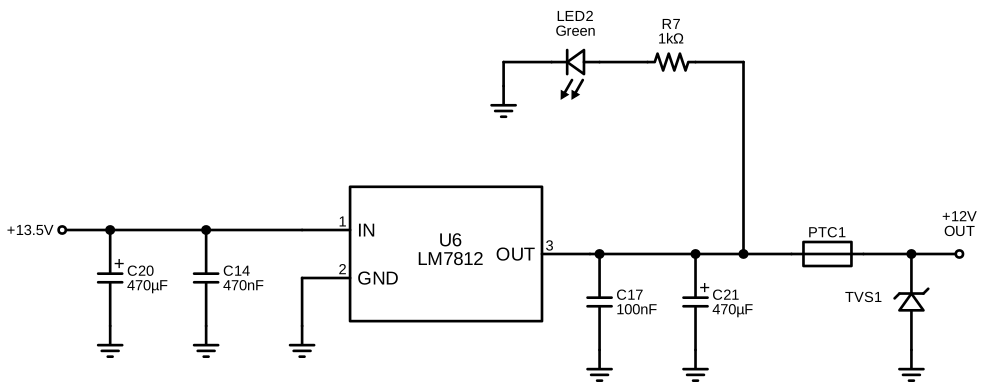
Capacitor Placement (Critical for PCB layout):
C17 (ceramic): Place RIGHT NEXT to the output pin (minimize trace length for high-freq filtering)
C14/C20/C21 (electrolytic): Can be placed farther from IC (bulk storage, less sensitive to distance)
Key Points:
Two-stage design: Buck converter (U2) provides efficient voltage reduction, linear regulator (U6) provides low-noise final output
Input capacitors: C14 and C20 — both 470µF/35V electrolytics on
+13.5V. Unlike U7/U8, this position carries no small ceramic on its input (board_b_spec.py:C14.1andC20.1are the only LDO-input pins on the+13.5V OUTnet)Output capacitor order: C17 (100nF ceramic, close to IC) and C21 (470µF/35V bulk, farther)
LED indicator: Green LED (LED2) with R7 (1kΩ) current-limiting resistor shows +12V rail is active
Dropout headroom is an open item: 13.5V − 12V leaves 1.5V against the L7812's 2.0V typical dropout at 1A, and DS0422 states no dropout figure at all at this rail's 1.2A load. Decision (f) in
scripts/deliberately makes no spec change here — the setpoint stays 13.5V and the margin is bench-gated, not resolvedschgen/ decisions. json
Protection Circuit (+12V rail, 1.2A design budget):
Protection layers: U6's own current limiting → U6's thermal shutdown → PTC1 trips (≥3.0A) → USB-PD source protection
PTC1: C7529589 (SMD1210P150TF/16, 16V) — 1.5A hold, 3.0A trip, auto-reset. Wave-6 replacement for the SMD1210P200TF (C20808), whose 6VDC Vmax was a blocker on a 12V rail (decision (g))
TVS1: SMAJ15A (unidirectional, 15V) - Overvoltage protection (cathode to +12V OUT, anode to GND)
Operation: Normal (<1.5A) = PTC low resistance, LED on; overload (1.5A–3.0A) = PTC warms toward trip over seconds while U6's faster electronic limit acts first; ≥3.0A = PTC1 trips; auto-reset after 30-60s cooling
U6's own limit thresholds are not sourced
The L7812CD2T evidence bundle retains no current-limit figure and no thermal-shutdown temperature. Figures like "≈2.2A limit" and "150°C shutdown" appeared in older revisions of this page and are not backed by DS0422 here — seeBoard B → PTC1 and the L7812 current-limit cascade. The ordering of the cascade is sound; the regulator-side numbers are not.
View ASCII art circuit
Regulator IC:
Connection List
Regulator: - U6 (L7812CD2T-TR): +13.5V input → Pin 1 (IN), Pin 3 (OUT) → +12V output, Pin 2 (GND) → GND Input Capacitors (connected in parallel between +13.5V and GND): - C14 (470µF/35V electrolytic): Input bulk stabilization - C20 (470µF/35V electrolytic): Input bulk stabilization Output Capacitors (connected in parallel between +12V and GND): - C17 (100nF ceramic): High-frequency decoupling - C21 (470µF/35V electrolytic): Output stabilization and transient response Protection (after the LDO output): - Net-(U6-OUT) → PTC1 (SMD1210P150TF/16) → +12V rail → TVS1.1 (cathode); TVS1.2 (anode) → GND Status LED: - LED2 (Green): +12V → R7 (1kΩ) → LED2 anode (pin 1) → LED2 cathode (pin 2) → GND - LED current: I = (12V - 2V) / 1kΩ ≈ 10mA
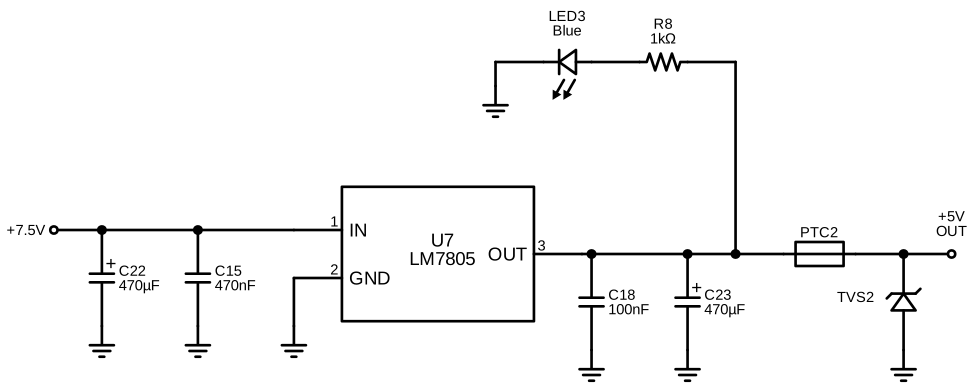
Diagram6: +7.5V → +5V Linear Regulator (L7805, U7)
Capacitor Placement (Critical for PCB layout):
C15/C18 (ceramic): Place RIGHT NEXT to IC pins (minimize trace length for high-freq filtering)
C22/C23 (electrolytic): Can be placed farther from IC (bulk storage, less sensitive to distance)
Key Points:
Two-stage design: Buck converter (U3) provides efficient voltage reduction, linear regulator (U7) provides low-noise final output
Input capacitor order: C22 (470µF/10V bulk, farther) and C15 (470nF ceramic, close to IC)
Output capacitor order: C18 (100nF ceramic, close to IC) and C23 (470µF/10V bulk, farther)
LED indicator: Blue LED (LED3) with R8 (1kΩ, 0805, LCSC C17513) current-limiting resistor shows +5V rail is active
LED current: I = (5V − 2.8V) / 1kΩ ≈ 2.2mA — dimmer than the ±12V indicators, which run ~10mA through the same 1kΩ value
Dropout voltage: LM7805 requires ~2V dropout, so 7.5V input provides 2.5V headroom
Protection Circuit (+5V rail, 0.5A design budget):
Protection layers: U7's own current limiting → U7's thermal shutdown → PTC2 trips (≥2.2A) → USB-PD source protection
PTC2: C70119 (mSMD110-33V, 33V) — 1.1A hold, 2.2A trip, auto-reset. 33V against a 5V rail is 28V of voltage margin
TVS2: SMAJ6.5A (C87267, unidirectional, VRWM 6.5V, SMA) — wave-6 replacement for the SD05 (C502527), whose 5V standoff sat at the rail's nominal and below the L7805's guaranteed 5.2V band top, so it could conduct during normal regulation (decision (a))
Operation: Normal (<1.1A) = PTC low resistance, LED on; overload (1.1A–2.2A) = PTC warms toward trip over seconds while U7's faster electronic limit acts first; ≥2.2A = PTC2 trips; auto-reset after 30-60s cooling
1.5A is a package capability, not this rail's budget
The +5V rail is budgeted at 0.5A (CLAUDE.md; the L7805ABD2T bundle records iout-ratingas 0.5A). 1.5A is a capability of the L78xx package family and is not a figure this design draws on — seeBoard B → PTC2 hold-current rationale.
View ASCII art circuit
Regulator IC:
Connection List
Regulator: - U7 (L7805ABD2T-TR): +7.5V input → Pin 1 (IN), Pin 3 (OUT) → +5V output, Pin 2 (GND) → GND Input Capacitors (connected in parallel between +7.5V and GND): - C15 (470nF ceramic): High-frequency noise filtering - C22 (470µF/10V electrolytic): Input bulk stabilization Output Capacitors (connected in parallel between +5V and GND): - C18 (100nF ceramic): High-frequency decoupling - C23 (470µF/10V electrolytic): Output stabilization and transient response Protection (after the LDO output): - Net-(U7-OUT) → PTC2 (mSMD110-33V) → +5V rail → TVS2.1 (cathode); TVS2.2 (anode) → GND Status LED: - LED3 (Blue): +5V → R8 (1kΩ) → LED3 anode (pin 2) → LED3 cathode (pin 1) → GND - LED current: I =
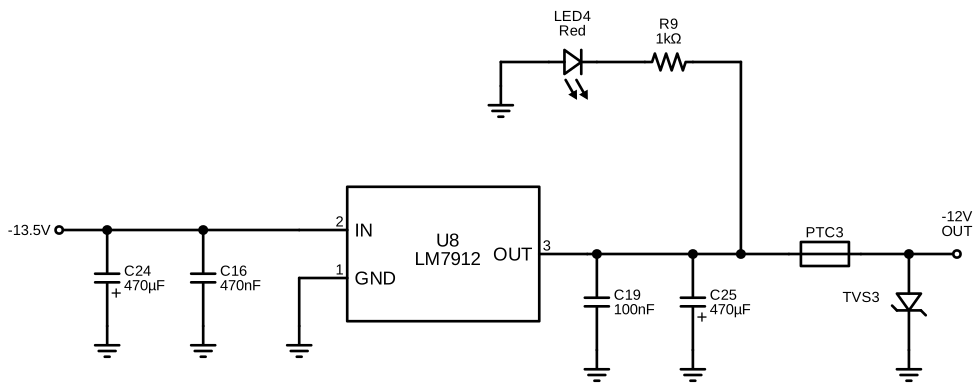
Diagram7: -13.5V → -12V Linear Regulator (CJ7912, U8)
Capacitor Placement (Critical for PCB layout):
C16/C19 (ceramic): Place RIGHT NEXT to IC pins (minimize trace length for high-freq filtering)
C24/C25 (electrolytic): Can be placed farther from IC (bulk storage, less sensitive to distance)
Important: Negative Voltage Component Polarities
Electrolytic capacitors REVERSED: C24 and C25 have negative terminal to negative voltage, positive terminal to GND
LED polarity REVERSED: LED4 anode to GND (0V, highest potential), cathode through R9 to -12V (lowest potential)
Key Points:
Two-stage design: Buck converter (U4) provides efficient voltage reduction, linear regulator (U8) provides low-noise final output
Input capacitor order: C24 (470µF/35V bulk, farther) and C16 (470nF ceramic, close to IC)
Output capacitor order: C19 (100nF ceramic, close to IC) and C25 (470µF/35V bulk, farther)
LED indicator: Red LED (LED4) with R9 (1kΩ) current-limiting resistor shows -12V rail is active
LED current: I = (0V - 2V - (-12V)) / 1kΩ = 10mA (current flows from GND through LED to -12V)
Dropout headroom: −13.5V in, −12V out leaves 1.5V. The CJ7912 bundle retains no dropout figure, so this is unverified against the part — treat it as a bench item of the same class as U6's (decision (f))
LM7912 pinout: Different from positive regulators - pin 1=GND, pin 2=IN, pin 3=OUT (79xx series)
Protection Circuit (-12V rail, 0.8A design budget):
Protection layers: U8's own current limiting → U8's thermal shutdown → PTC3 trips (≥3.0A) → USB-PD source protection
PTC3: C883133 (BSMD1206-150-16V, 16V) — 1.5A hold, 3.0A trip, auto-reset. Its 85°C-derated hold (0.77A) sits just under the 0.8A budget — a bench item (finding BB-8)
TVS3: SMAJ15A (unidirectional, 15V) - Anode (pin 2) to -12V rail, Cathode (pin 1) to GND (reversed for negative rail; orientation locked by decision
tvs3-orientationas explicit pin-to-net rows inboard_b_spec.py)Operation: Normal (<1.5A) = PTC low resistance, LED on; overload (1.5A–3.0A) = PTC warms toward trip over seconds while U8's faster electronic limit acts first; ≥3.0A = PTC3 trips; auto-reset after 30-60s cooling
View ASCII art circuit
Regulator IC:
Connection List
Regulator: - U8 (CJ7912): Pin 1 (GND) → GND, Pin 2 (IN) ← -13.5V input, Pin 3 (OUT) → -12V output - Note: LM7912 pinout differs from LM7812/7805: pin 1=GND, pin 2=IN, pin 3=OUT (79xx negative regulators) Input Capacitors (connected in parallel between -13.5V and GND): - C16 (470nF ceramic): High-frequency noise filtering - C24 (470µF/35V electrolytic): Input bulk stabilization - Polarity: Negative terminal to -13.5V, Positive terminal to GND Output Capacitors (connected in parallel between -12V and GND): - C19 (100nF ceramic): High-frequency decoupling - C25 (470µF/35V electrolytic): Output stabilization and transient response - Polarity: Negative terminal to -12V, Positive terminal to GND Protection (after the LDO output): - Net-(U8-OUT) → PTC3 (BSMD1206-150-16V) → -12V rail → TVS3.2 (anode); TVS3.1 (cathode) → GND Status LED: - LED4 (Red): GND → LED4 anode (pin 2) → LED4 cathode (pin 1) → R9 (1kΩ) → -12V - LED current: I = (0V - (-12V) - 2V) / 1kΩ = 10mA - Note: LED is reversed compared to positive rails (anode to GND, cathode to negative voltage)